2025 at a glance


Our sustainability commitments matter. They protect the environment, support communities, reduce risk, and ensure the company remains viable and competitive in a world where responsible mining is non‑negotiable.

Revenue

(2024: $5.8bn)

Gold production

(2024: 2.66Moz)

Gold Mineral Reserve

(2024: 31.2Moz)

People employed

employees and contractors on average

(2024: 36,496)

Total recordable injury frequency rate (TRIFR)

(2024: 0.98)

Training and development expenditure

(2024: $7.99m)

Salaries, wages and benefits paid to employees

(2024: $796m)

Community investment

(2024: $20.56m)

Expenditure with local suppliers

(2024: $4.26bn (92%))

Grievances resolved

(2024: 93%)

Reportable environmental incidents

(2024: 1)

Cumulative amount of land rehabilitated

(2024: 4,271ha)

Renewable energy supply

(2024: 6.6%)

Scope 1 and Scope 2 greenhouse gas (GHG) emissions

(2024: 1.473Mt)

Employees that completed ethics training*

(2024: 5,697)

Payments to government ∧

(2024: $1.03bn)

Security personnel trained on human rights policies

(2024: 100%)

Excludes Centamin

Excludes Kibali

* Excludes contractors

Refer to ESG Data Workbook for breakdown

Leadership


Determining materiality


We are cognisant that material sustainability issues change over time (dynamic materiality), and we will continue to monitor the broader range of issues, including emerging issues.

While we have grouped the sustainability issues identified into related environment, social, governance and economic topics, we recognise that these issues are deeply interrelated and inter-dependent and should be considered and managed accordingly.

The Company’s double materiality assessment is integrated into the Enterprise Risk Management (ERM) framework ensuring the Company considers a comprehensive view of risks and opportunities that may affect not only its financial outcomes but also its broader societal and environmental responsibilities.

Our 2025 materiality assessment included detailed interviews with key internal and external stakeholders, and considered new and emerging disclosure regulations including GRI and SASB. Extractives and mineral processing are among the first industries scheduled for updated SASB-aligned guidance, with new emphasis expected in areas such as biodiversity, water use, tailings, land disturbance, workforce conditions, closure planning and community impacts. These developments informed our framing of material sustainability issues this year, ensuring that our prioritisation reflects future regulatory direction rather than only historical expectations.

Impact materiality

Whether a matter is material from an impact perspective, that is, whether AngloGold Ashanti’s activities have a material actual or potential impact, positive or negative, on people, society and/or the environment over the short, medium or long term.

Financial materiality

Whether a matter is material from a financial perspective and whether it triggers potential or actual financial effects on AngloGold Ashanti, that is, whether it leads to risks or opportunities that influence or could influence future cash flows and the enterprise value of the Company in the short, medium or long term.

Initial benchmarking involved a thorough review of global standards and voluntary compacts to which we subscribe and align with, peer practices and feedback from ratings agencies, as well as prior year assessments.This benchmarking ensured that the issues considered are relevant, comprehensive and reflect both industry best practice and stakeholder expectations. We then arrived at a comprehensive long list of sustainability topics relevant to AngloGold Ashanti’s footprint and industry context, which we carefully refined to identify 33 issues that are relevant to our industry and sector.

We held structured interviews with internal and external stakeholders/leaders to understand:

  • Strategic priorities
  • Operational challenges and dependencies
  • Regional sustainability expectations
  • Emerging risks and opportunities

This process resulted in a refined list of 21 material sustainability issues, including new issues, strengthened definitions, and determining how issues influence our ability to create, sustain, or potentially erode social, environmental, and economic value from both an impact and financial materiality perspective.

Finally, members of executive and senior management were asked to rank issues from the perspective of both impact and financial materiality, based on our definitions (alongside). Respondents were also asked to indicate the time horizon –short, medium and long term – associated with impacts and, for financial materiality, whether the issue was primarily a risk or an opportunity.

These issues were then reviewed by the internal sustainability team. The ranking was adjusted to reflect broader industry sustainability issues and issues raised by stakeholders. These results were analysed and combined with internal insights to determine the 17 material sustainability issues for 2025.

Our commitments


Case studies


Assurance


As a member of the International Council on Mining & Metals (ICMM), AngloGold Ashanti plc is committed to obtaining independent external assurance over its conformance with the ICMM Mining Principles, including specified disclosures presented in its 2025 Sustainability Report


Our commitment

Recognising that ASM is a source of employment and income generation in many countries, we are committed to advancing the formalisation and professionalisation of ASM to reduce its risk to people, environment and our business.

This commitment is backed by our pledge to co-operate with the governments, communities, NGOs and international bodies focused on crafting a co-existence framework promoting safe and sustainable futures for all.

  • Encouraging greater supply chain transparency
  • Working with international organisations, national governments and communities to progress formalisation and professionalisation of ASM
  • Seeking ways to work with artisanal miners to promote inclusive growth and economic opportunities

Performance in 2025

ASM and illegal mining remains a major social, environmental and operational risk at some of our operations.

In many gold mining locations, artisanal mining is the most attractive way to make a living. This is particularly so in rural areas, where formal employment opportunities are scarce, and in areas where traditional forms of livelihood, such as agriculture, are no longer viable due to changes in the climate.

According to World Bank estimates, at least 45 million people in 80 countries engage in ASM, with over 315 million active in the informal mining value chain across Latin America, Africa and Asia. The bank estimates that this informal sector contributes about 20% of global gold supply but only 25% to 35% of these miners comply with regulations.

Considering that most activities in the ASM sector are informal and outside of legal frameworks, ASM remains a key material sustainability risk for AngloGold Ashanti with the loss of gold-bearing ore, environmental degradation, the use of dangerous chemicals and human rights violations against vulnerable groups being our primary concern.

Infrastructure sabotage (cables, ventilation); unauthorised mine entry; use of illegal explosives

AngloGold Ashanti’s mitigation measures:
  • Integrated Security Management Systems
  • Physical barriers and site demarcation
  • Joint concession monitoring

Presence of armed syndicates; ‘turf wars’ in communities; coercion/bribery of formal employees

AngloGold Ashanti’s mitigation measures:
  • Partnering with national law enforcement
  • Community based policing
  • Internal governance controls

Mercury/cyanide contamination in residential areas; ground instability (sinkholes) under public roads

AngloGold Ashanti’s mitigation measures:
  • Environmental monitoring
  • ASM formalisation
  • Awareness training and capacity building
  • Partnering with civic organisation

Community protests; loss of social licence to operate; forced and child labour in the value chain

AngloGold Ashanti’s mitigation measures:
  • Alternative livelihood programmes
  • Engagement and grievance mechanisms
  • Social impact assessments

Potential for security force overreach; displacement of artisanal miners

AngloGold Ashanti’s mitigation measures:
  • VPSHR compliance and training programme
  • Human rights due diligence
  • Engagement and grievance mechanisms
  • Contribute to the formalisation and regulation of legal ASM, integrated into broader social and economic activities
  • Advocate for policy frameworks and practices that foster a viable and sustainable legal ASM sector, collaborating with ICMM and the WGC to enhance industry practices in dealing with ASM
  • Consider geological research to identify suitable zones for legal ASM, a consideration applied within broader land access discussions
  • Develop programmes to promote the transfer of knowledge, skills and technologies to the legal ASM sector, with a particular focus on safety and environmental practices
  • Identify potentially viable legal ASM operations for targeted support, aiming to enhance access to markets, better mining technology, and mercury-free processing methods
  • Promote downstream value addition in legal ASM, supporting inclusive growth and economic activities
  • Contribute to the development and strengthening of legal ASM associations, providing an interface for meaningful engagement with the sector

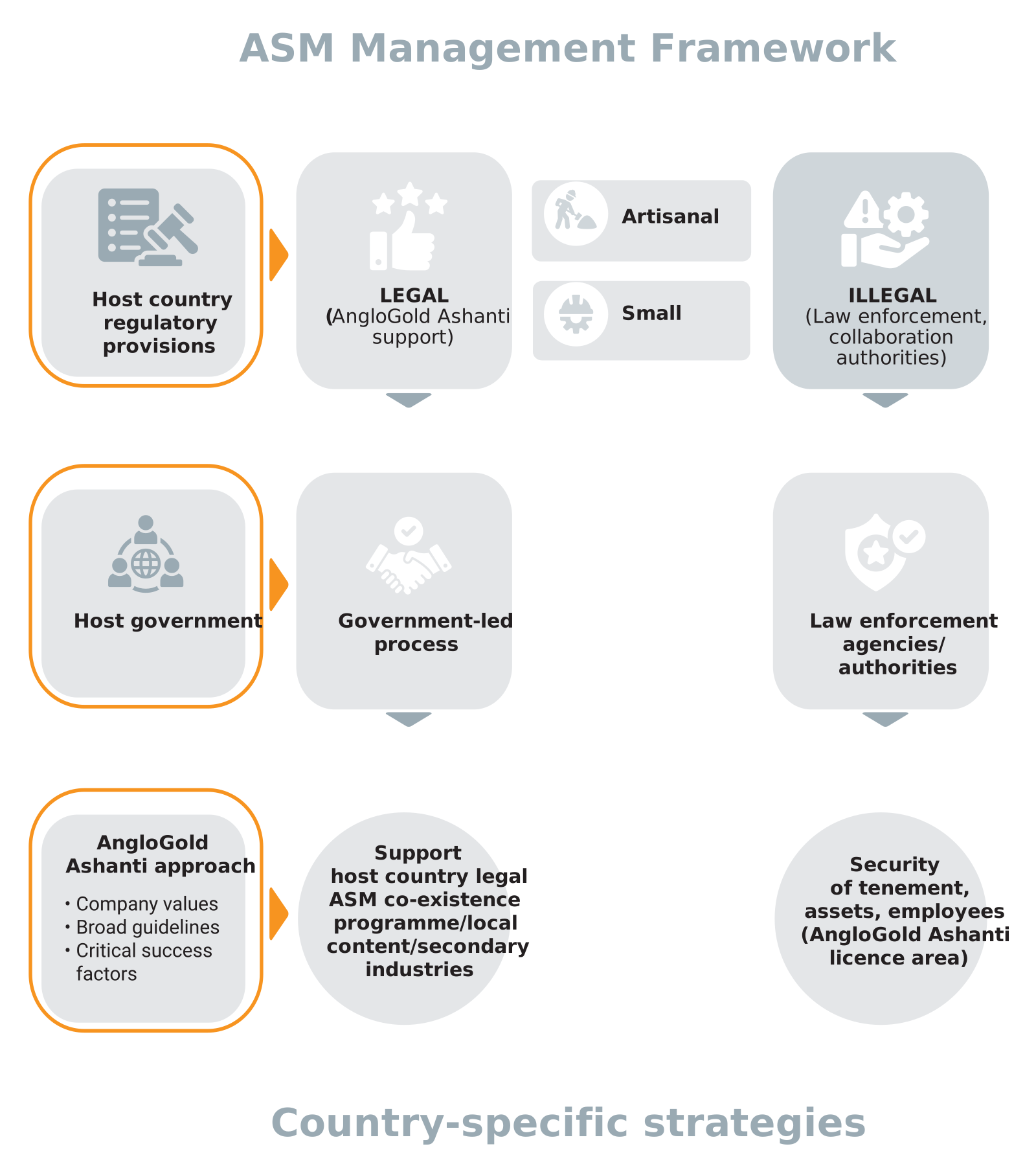
ASM activities increased in 2025 as climbing gold prices offered a stronger financial incentive to increase mining production. While the risks associated with unregulated ASM and illegal mining on, or around, our tenements are mostly not within our direct control, our sites are guided by our ASM Management Standard.

The objective of the ASM Management Standard is to ensure that where ASM is present in our tenement or lease areas, site specific procedure and plans are developed and implemented. Premised on legal provisions and the socioeconomic context of the host countries, these plans aim to reduce the negative safety, security, environmental and impact of informal mining activities while promoting the development of orderly, viable ASM sectors in collaboration with host communities and governments.

The UN estimates that ASM is the largest source of mercury pollution globally, releasing approximately 838 tonnes of mercury into the environment each year. Studies show mercury contamination in water bodies near illegal mining sites often exceeds WHO safety standards by up to 500 times, making it unsafe for human consumption, even washing or irrigating crops.

A structured co-existence framework supports the sustainability of the ASM sector through capacity building and access to cleaner, more efficient technologies, while reducing key environmental impacts such as cyanide pollution, soil disturbances and deforestation.

Our work with international organisations, national governments and communities to progress the formalisation of ASM remains a core focus as we look to transform this unregulated challenge into an opportunity for community and sustainable development.

During 2025, Ghana and Tanzania moved to capture more of this informal production in the official net, which could improve state regulation and oversight. Recognising ASM as one of the great challenges for society, the Ghanaian government has set aside significant political, financial and human resources to find ways of integrating artisanal miners into the formal economy. The integration of the ASM sector into economies should improve supply chain transparency and curb illicit trade.

The government of Ghana is advancing a policy-led approach to formalise the ASM sector, overseen by the Minister for Lands and Natural Resources through the Community Cooperative Mining Scheme. In this context, the minister has encouraged large-scale mining companies to facilitate access to prospective land for regulated ASM activity. In Obuasi, a technically feasible land area of approximately 1 km² at Kokoteasua has been identified for allocation under the Government’s Responsible Cooperative Mining and Skills Ghana Development Programme. The programme is aimed at promoting responsible ASM mining and is carried out in partnership with the Minerals Commission, the Responsible Cooperative Mining and Skills Development campaign, the Ghana National Association of Small-scale Miners, and ASM member groups. In Guinea, a multi-stakeholder engagement forum on ASM-related injuries and fatalities has also been established in Siguiri to enhance community awareness, strengthen safety education, and proactively address risks to local communities. As part of our commitment to the formalisation and development of a responsible ASM framework, we remain an active participant in a multi-stakeholder partnership with the government of Guinea, the United Nations Environment Programme, and other key stakeholders.

We are watching with interest the promising multi-stakeholder partnership initiative led by the World Bank, the World Gold Council and the government in neighbouring Cote D’Ivoire. This is well financed, well-conceived, and will hopefully create a route map for similar initiatives.

ASM and illegal mining remains a major social risk across the Group. Third-party fatalities from illegal mining activities on mine concessions and non-active operational areas continued on an upward trend in 2025, demonstrating the sharp increase in ASM amid record gold prices.

More community fatalities were reported during the year, and most of these events were related to ASM activities that usually lead to fall of ground. 88 community fatalities were reported during 2025, and most of these were in Siguiri due to fall of ground incidents at the unsafe illegal mining sites across the concession.

At Obuasi, the growing challenge presented by illegal mining, particularly in the context of record prices, was evident in the first quarter when illegal miners attempting to breach the perimeter of the Obuasi concession fired on public security personnel at the scene. Tragically, nine of the illegal miners lost their lives and 14 were injured when military personnel returned fire. While AngloGold Ashanti security staff were not involved in the incident, an intensive programme of stakeholder outreach followed, with engagements held with local faith and traditional leaders, government and members of local communities to help address the underlying drivers of these incidents. AngloGold Ashanti actively supported and co-operated fully with investigations by local and national authorities, and also offered humanitarian assistance to those affected.

Looking ahead

In 2026, we intend to:

  • Continue to support the institutionalisation of end-to-end traceability to ensure a transparent, conflict-free supply chain aligned with international standards
  • Continue the partnership with governments and NGOs to transition ASM into a regulated, professional, and safe industry
  • Shift from defensive security to proactive governance, reducing operational risk and criminal influence
  • Drive shared value through livelihood diversification and economic opportunities for community members
  • Support the reduction of environmental and health hazards through capacity building and professionalised mining standards

  • Addressing ASM and illegal mining
  • Securing our social licence to operate through effective stakeholder engagement and community support
  • Respecting human rights and the rights of indigenous people
  • Managing nature and biodiversity, including land use, rehabilitation and closure
  • Ensuring water security and stewardship

For more information on principal risks see the 2025 Annual Report

  • Inability to manage interaction with artisanal and small-scale mining (including illegal mining)
  • Failure to meet our human rights obligations
  • GRI 14.13.1:
    1. Describe the approach to engaging with ASM operators, and the actions taken by the organisation to support ASM formalization and professionalization efforts.
    2. Describe the programs in place to enhance positive impacts or mitigate negative impacts involving ASM, including:
      • whether and how the programs incorporate gender considerations
      • how engagement with local authorities and communities has informed the programs.
    3. If sourcing from artisanal and small-scale mining, describe the policies in place and the process used to identify and assess actual and potential negative impacts.
  • GRI 14.13.2: List the mine sites where ASM occurs on or in close proximity to the site.
  • GRI 14.13.3: Report the total number and nature of incidents involving ASM and actions taken.
  • ICMM Responsible Mining Principle 9.3: Social performance: Collaborate with government, where appropriate, to support improvements in environmental and social practices of local artisanal and small-scale mining (ASM).
  • WGC Responsible Gold Mining Principle 3.3: Supply chain: We support access to legitimate markets for those ASM who respect applicable legal and regulatory frameworks, who seek to address the environmental, health, human rights and safety challenges often associated with ASM activity, and who, in good faith, seek formalisation.
Number of operations/sites adjacent to ASM

(2024: 8)

Number of countries across footprint with formalised ASM

(2024: 2)

Number of ASM engagements

(2024: 8)

Number of co-operation agreements in place with ASM

(2024: 0)

Number of livelihood projects

(2024: 8)

Disclaimer

This webpage does not purport to be a complete summary of the applicable underlying report and is qualified in its entirety by reference to the applicable underlying report. This webpage should be read in conjunction with the applicable underlying report, including the qualifications and limitations described therein, as there may be information in the applicable underlying report that may be important.

All Mineral Resource and Mineral Reserve information should be read in conjunction with Item 4D. Mineral Resource and Mineral Reserve in AngloGold Ashanti’s annual report on Form-20F for the fiscal year ended 31 December 2025, as filed with the U.S. Securities and Exchange Commission, as well as AngloGold Ashanti’s 2025 Mineral Resource and Mineral Reserve Report.

Forward-looking statements

Certain statements contained in this webpage, other than statements of historical fact, including, without limitation, those concerning the economic outlook for the gold mining industry, expectations regarding gold prices, production, mine life, total cash costs, all-in sustaining costs, cost savings and other operating results, return on equity, productivity improvements, growth prospects, preliminary financial and production metrics for in-process projects, the ability to convert Mineral Resource into Mineral Reserve and replace Mineral Reserves net of depletion from production and outlook of AngloGold Ashanti’s operations, individually or in the aggregate, including the achievement of project milestones, commencement and completion of commercial operations of certain of AngloGold Ashanti’s exploration and production projects and the completion of acquisitions, dispositions or joint venture transactions, AngloGold Ashanti’s liquidity and capital resources and capital expenditures and the outcome and consequences of any potential or pending litigation or regulatory proceedings or environmental, health and safety issues, are forward-looking statements regarding AngloGold Ashanti’s financial reports, operations, economic performance and financial condition.

These forward-looking statements or forecasts are not based on historical facts, but rather reflect our current beliefs and expectations concerning future events and generally may be identified by the use of forward-looking words, phrases and expressions such as “believe”, “expect”, “aim”, “anticipate”, “intend”, “foresee”, “forecast”, “predict”, “project”, “estimate”, “likely”, “may”, “might”, “could”, “should”, “would”, “seek”, “plan”, “scheduled”, “possible”, “continue”, “potential”, “outlook”, “target” or other similar words, phrases, and expressions; provided that the absence thereof does not mean that a statement is not forward-looking. Similarly, statements that describe our objectives, plans or goals are or may be forward-looking statements.

These forward-looking statements or forecasts involve known and unknown risks, uncertainties and other factors that may cause AngloGold Ashanti’s actual results, performance, actions or achievements to differ materially from the anticipated results, performance, actions or achievements expressed or implied in these forward-looking statements. Although AngloGold Ashanti believes that the expectations reflected in such forward-looking statements and forecasts are reasonable, no assurance can be given that such expectations will prove to have been correct. Accordingly, results, performance, actions or achievements could differ materially from those set out in the forward-looking statements as a result of, among other factors, changes in economic, social, political and market conditions, including related to inflation or international conflicts, the success of business and operating initiatives, changes in the regulatory environment and other government actions, including environmental approvals, fluctuations in gold prices and exchange rates, the outcome of pending or future litigation proceedings, any supply chain disruptions, any public health crises, pandemics or epidemics, the failure to maintain effective internal control over financial reporting or effective disclosure controls and procedures, the inability to remediate one or more material weaknesses, or the discovery of additional material weaknesses, in the Company’s internal control over financial reporting, and other business and operational risks and challenges and other factors, including mining accidents. For a discussion of such risk factors, refer to the Company’s annual report on Form 20-F for the financial year ended 31 December 2025, filed with the U.S. Securities Exchange Commission. These factors are not necessarily all of the important factors that could cause AngloGold Ashanti’s actual results, performance, actions or achievements to differ materially from those expressed in any forward-looking statements. Other unknown or unpredictable factors could also have material adverse effects on AngloGold Ashanti’s future results, performance, actions or achievements. Consequently, readers are cautioned not to place undue reliance on forward-looking statements.

AngloGold Ashanti undertakes no obligation to update publicly or release any revisions to these forward-looking statements to reflect events or circumstances after the date of publication or to reflect the occurrence of unanticipated events, except to the extent required by applicable law. All subsequent written or oral forward-looking statements attributable to AngloGold Ashanti or any person acting on its behalf are qualified by the cautionary statements herein.

NON-GAAP financial measures

This document may contain certain “Non-GAAP” financial measures, including, without limitation, “total cash costs”, “total cash costs per ounce”, “all-in sustaining costs”, “all-in sustaining costs per ounce”, “average gold price received per ounce”, “sustaining capital expenditure”, “non-sustaining capital expenditure”, “Adjusted EBITDA”, “Adjusted net debt (cash)”, “operating cash flow” and “free cash flow”. AngloGold Ashanti utilises certain Non-GAAP performance measures and ratios in managing its business. Non-GAAP financial measures should be viewed in addition to, and not as an alternative for, the reported operating results or cash flow from operations or any other measures of performance prepared in accordance with IFRS. In addition, the presentation of these measures may not be comparable to similarly titled measures other companies may use. Reconciliations from IFRS to the Non-GAAP financial measures used in this document can be found either in this document, or in AngloGold Ashanti’s Earnings Release for the three months and the year ended 31 December 2025, which is available on AngloGold Ashanti’s website, or in its annual report on Form 20-F for the financial year ended 31 December 2025 as filed with 
the SEC.

2025 Mineral Resource and Mineral Reserve information

The Mineral Resource and Mineral Reserve stated herein were prepared in compliance with Subpart 1300 of Regulation S-K (17 CFR § 229.1300) (“Regulation S-K 1300”). Refer to Item 1300 (Definitions) of Regulation S-K for the meaning of the terms used in AngloGold Ashanti’s Mineral Resource and Mineral Reserve reporting. The Mineral Resource and Mineral Reserve represent the amount of gold, copper, silver, sulphur and molybdenum estimated at 31 December 2025 and are based on information available at the time of estimation. Such estimates are, or will be, to a large extent, based on the prices of the respective commodities and interpretations of geologic data obtained from drill holes and other exploration techniques, which data may not necessarily be indicative of future results. The Mineral Resource and Mineral Reserve estimates are published at 31 December 2025, taking into account economic assumptions, changes to future production and capital costs, depletion, additions as well as any acquisitions or disposals during 2025. The legal tenure of each material property has been verified to the satisfaction of the accountable Qualified Person and all of the Mineral Reserve has been confirmed to be covered by the required mining permits or there exists a realistic expectation, based on applicable laws and regulations, that issuance of permits or resolution of legal issues necessary for mining and processing at a particular deposit will be accomplished in the ordinary course and in a timeframe consistent with AngloGold Ashanti’s (or its joint venture partners’) current mine plans. For the Mineral Reserve, the term “economically viable” means that profitable extraction or production has been established or analytically demonstrated in, at a minimum, a pre-feasibility study, to be economically viable under reasonable investment and market assumptions. Mineral Reserve is subdivided and reported, in order of increasing geoscientific knowledge and confidence, into Probable and Proven Mineral Reserve categories. Mineral Reserve is aggregated from the Probable and Proven Mineral Reserve categories. Ounces of gold or silver or pounds of copper or sulphur included in the Probable and Proven Mineral Reserve are estimated and reported as delivered to plant (i.e., the point where material is delivered to the processing facility) and exclude losses during metallurgical treatment. In compliance with Regulation S-K 1300, the Mineral Resource herein is reported as exclusive of the Mineral Reserve before dilution and other factors are applied, unless otherwise stated. Mineral Resource is subdivided and reported, in order of increasing geoscientific knowledge and confidence, into Inferred, Indicated and Measured Mineral Resource categories. Ounces of gold or silver or pounds of copper, sulphur or molybdenum included in the Inferred, Indicated and Measured Mineral Resource are those contained in situ prior to losses during extraction and processing. While it would be reasonable to expect that the majority of Inferred Mineral Resource would upgrade to Indicated Mineral Resource with continued exploration, due to the uncertainty of Inferred Mineral Resource, it should not be assumed that such upgrading will always occur.

If estimations must be revised due to significantly lower commodity prices, increases in operating costs, reductions in metallurgical recovery or other factors, the Mineral Resource or Mineral Reserve may not be mined or processed profitably. In addition, material write-downs of AngloGold Ashanti’s investment in its mining properties may be required, including impacts on goodwill, as well as increased amortisation, reclamation and closure charges. If AngloGold Ashanti determines that certain parts of its Mineral Resource or Mineral Reserve have become uneconomic, this may ultimately lead to a reduction in its reported aggregate Mineral Resource or Mineral Reserve, respectively. Consequently, if AngloGold Ashanti’s actual Mineral Resource and Mineral Reserve is less than current estimates, its business, prospects, results of operations and financial position may be materially impaired.

Pre-feasibility and feasibility studies for undeveloped ore bodies present estimated capital expenditure and operating costs based on anticipated tonnage and grades of ore to be mined and processed. Other factors underlying the estimations include, among others, the predicted configuration of the ore body, anticipated metal recovery rates, and estimated costs of operating and processing equipment and facilities. Actual operating and capital expenditure cost and economic returns on projects may differ significantly from original estimates. Further, it may take many years from the initial phases of exploration until commencement of production, during which time, the economic feasibility of production may change. The Mineral Resource is subject to further exploration and development, and is subject to additional risks, and no assurance can be given that they will eventually convert to Mineral Reserve.

For additional information, refer to Table 1 (Summary Mineral Resource) and Table 2 (Summary Mineral Reserve) to Paragraph (b) of Item 1303 (Summary disclosure) of Regulation S-K, which are in AngloGold Ashanti’s annual report on Form 20-F for the financial year ended 
31 December 2025 filed with the SEC. These summary tables include each class of Mineral Resource (Inferred, Indicated and Measured) together with total Measured and Indicated Mineral Resource, and each class of Mineral Reserve (Probable and Proven) together with total Mineral Reserve. The Mineral Resource at the end of the financial year ended 31 December 2025 was estimated using a gold price of $2,000/oz (2024: $1,900/oz), a copper price of $3.50/lb (2024: $3.50/lb), a silver price of $23.00/oz (2024: $23.00/oz) and a molybdenum price of $12.00/lb (2024: $12.00/lb), unless otherwise stated. The Mineral Reserve at the end of the financial year ended 31 December 2025 was estimated using a gold price of $1,700/oz (2024: $1,600/oz), a copper price of $3.10/lb (2024: $2.90/lb) and a silver price of $19.50/oz 
(2024: $19.50/oz), unless otherwise stated. The net difference between the Mineral Resource and Mineral Reserve at the end of the last completed financial year and the preceding financial year will be detailed for material properties, if applicable, in AngloGold Ashanti’s annual report on Form 20-F for the financial year ended 31 December 2025.

The Mineral Resource exclusive of Mineral Reserve is defined as the inclusive Mineral Resource less the Mineral Reserve before dilution and other factors are applied.